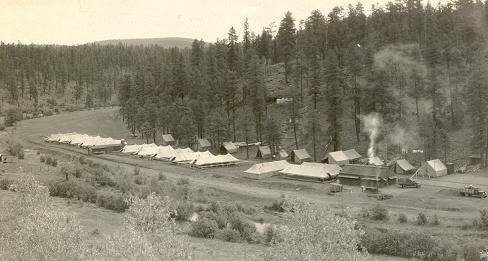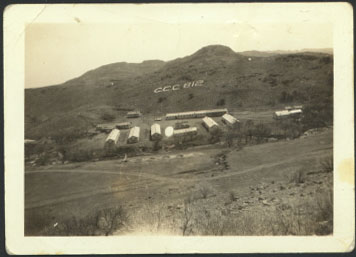


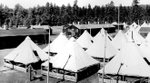
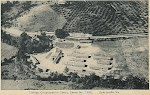
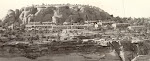
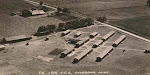
 So often, the locations of former CCC camps are lost to history or perhaps known only to a few local residents and historians. Sadly, when the last of the locals pass away, they may likely take with them the last bit of knowledge regarding where the CCC camp stood in their neighborhood. In the future, it will fall to local historians to document this information and the better the documentation, the better the preservation.
While doing a Google blog search for posts related to the Civilian Conservation Corps, I came across the blog Mysteries and Conundrums where there was posted an article entitled A Camp in the Wilderness: CCC Camp MP-4. Please read it; it’s as good a bit of CCC sleuthing as you’re likely to find anywhere on the net. The author provides not only an excellent bit of geo-referencing that includes a comparison of aerial photos from the 1930s and today, but also some fascinating background on the camp and its baseball diamond.
There is a similarly situated CCC camp in the Phoenix area (actually the site of two camps) and, unless you’re a CCC historian, a park ranger or perhaps an avid hiker, you’d likely miss the signs that tell you that a community of up to 400 young workers once lived in the area. The original flagpole base – likely constructed by enrollees from Texas – is still in place, but hidden by native vegetation and likely protected from vandalism as a result.

Which brings us to the potential downside of knowing about and revealing the locations of these old CCC camp sites. How much information is too much information? Fortunately, what little remains of Camp MP-4 is likely protected simply because it rests within the Fredricksburg and Spotsylvania County Battlfields Memorial, and likewise, the Phoenix CCC camp is inside a City of Phoenix Park, but what of the hundreds of CCC camps spread throughout the forests and fields of the United States. Fact is, most will continue to decay in silent anonymity, prey to the odd vandal or treasure hunter digging for artifacts, but mostly giving in to the unstoppable march of time and the ravages of mother nature.
All of which, leads me to another interesting topic: the work of the CCC at Civil War battlefield sites. Perhaps a post for next time.
Meantime, some snapshots of CCC camp remnants that I’ve visited….
Two views of what is left of Camp Custer in South Dakota...


A shot of the old dynamite bunker at the CCC camp site in Cumberland Falls near Corbin, Kentucky.....
 Two stone pillars are almost all that remain of the two CCC camps that once operated at Phoenix South Mountain Park, but if you look closely when you're there, you might find the old flagpole stand, too!
 It's anyone's guess what this concrete structure was used for at the old Lynx Creek CCC camp near Prescott, Arizona.
 This is the floor of the old latrine and shower building at the former site of the Walnut Creek CCC camp, also near Prescott, Arizona.
 There are a number of remains at the site of the Schultz Pass CCC camp outside Flagstaff, Arizona. Look carefully and you'll see porcelain insulators and wires strung in the trees....
 ...and the concrete floors of a number of buildings including what was probably the mess hall and the officer's quarters.
But perhaps the neatest CCC camp remnant in Arizona is this "monument" built by CCC enrollees at the Indian Gardens camp near Payson, Arizona....
 It's easily accessible, without so much as a five step walk off a major road, but it's only there for those who truly want to see it. If you whiz by at 50 miles per hour, you'll miss it.